What is Cheong?
In Korean cuisine, the word Cheong (淸) originally meant "honey." In past, raw honey collected from cliff crevices was called Seok-cheong (rock honey), while honey harvested from inside hollow trees was known as Mok-cheong (wood honey).
As time passed, the term expanded. Because pure honey was a rare luxury, Koreans developed Jo-cheong (grain syrup) by fermenting and reducing grains into a thick, honey-like consistency. In modern era, Cheong has evolved to encompass a broad category of sweet, aromatic syrups made by fruits in sugar or honey.
Depending on how it’s made, Cheong falls into two main types
Heated Cheong
Ingredients are boiled and reduced over heat to drive off moisture.
Ex) traditional grain syrup (Jo-cheong), pear-ginger Cheong (Bae-doraji-cheong)
Unheated Cheong
Raw ingredients and sugar are combined in a 1:1 weight ratio and allowed to macerate at room temperature without any heat applied
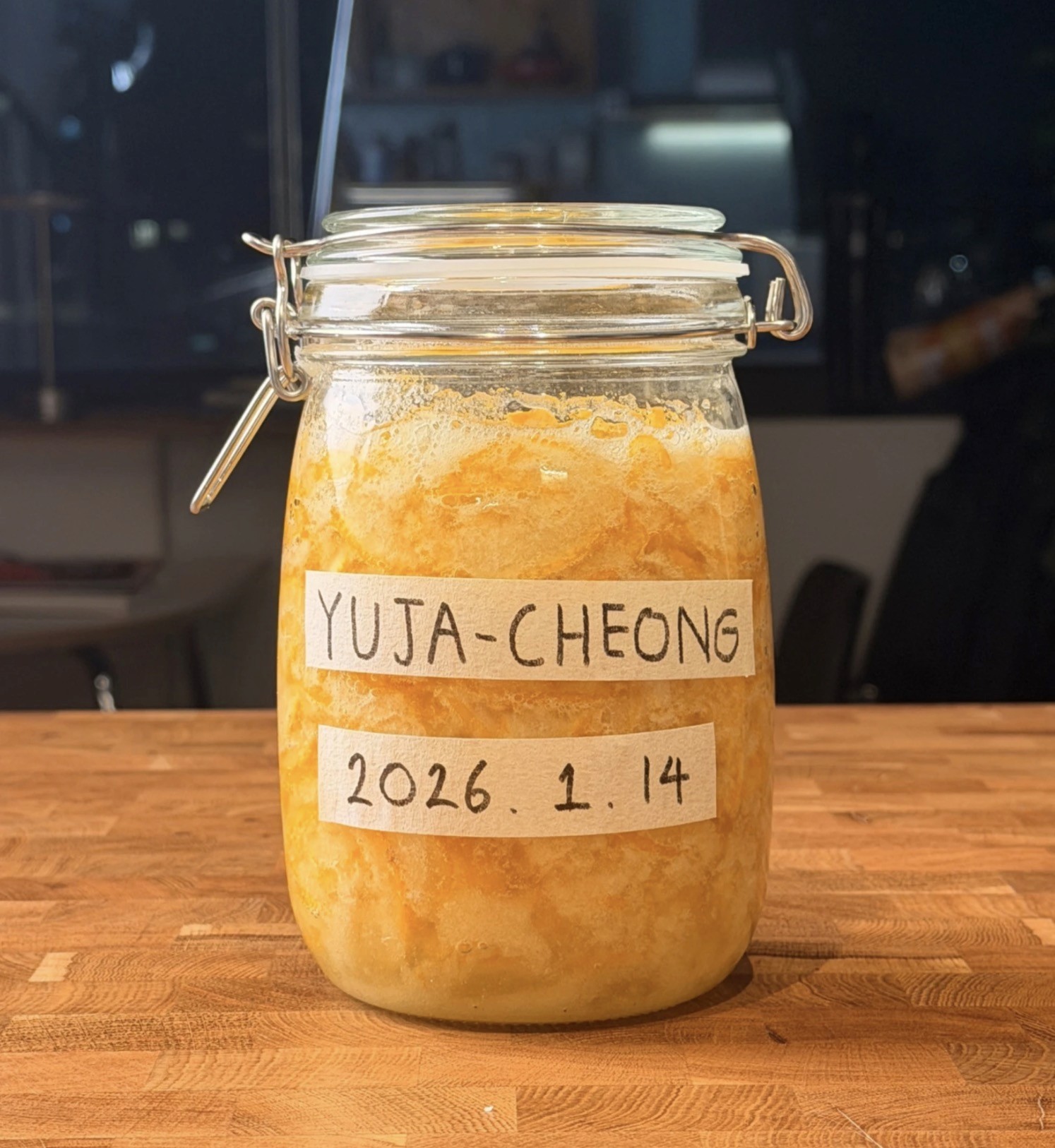
Ex) Maesil-cheong, Yuja-cheong
While 'Heated Cheong' share similarities with Western reductions like Jam, when Koreans talk about Cheong today, they almost always mean 'Unheated Cheong' (Dangchim-cheong). So now I'm going to talk about 'Unheated Cheong' in this page. And From now on, Cheong mean 'Unheated Cheong'
Why Was Cheong Created?
Korea have four distinct seasons, each bringing a fleeting wave of seasonal produce. In an era before refrigeration, lush summer berries or autumn citrus would spoil within days once harvested.
This challenge birthed a simple question: "How can we capture the peak flavor, fragrance, and vitality of seasonal fruits to enjoy them all year long?"
For vegetables, Koreans developed 'Jangajji'. For fruits, they developed Cheong.
The Ultimate Benefit: Preserving Raw Volatiles & Nutrients
Unlike jams or fruit preserves that require boiling, cold-extracted Cheong undergoes zero heat treatment. Heat-sensitive nutrients like Vitamin C and delicate organic acids remain fully intact. More importantly, the volatile aromatic compounds—the fresh, floral "top notes" of raw fruit—are trapped directly inside the sugar matrix rather than escaping into steam.
Cheong vs. Marmalade & Jam
Feature
Cheong (Dangchim / Cold Extraction)
Marmalade & Jam
Method
Unheated cold extraction (Osmosis)
High-heat boiling & reduction
Texture
Fluid, pourable liquid syrup + intact fruit pieces
Thick, gelled matrix (via Pectin)
Flavor Profile
Fresh, bright, and floral (raw fruit character)
Cooked, caramelized, and concentrated sweetness
Versatility
Dissolves effortlessly into cold liquids & sauces
Best suited as a spreadable condiment
How Cheong is Made: The Step-by-Step Method
Step 1 : Wash and Dry
Wash the fruits using baking soda or vinegar to remove surface wax and pesticides. Dry the fruit completely
Step 2 : Weigh a 1:1 Ratio
Weigh equal parts fruit and sugar by weight. White sugar, raw cane sugar, or honey can be used depending on the desired flavor profile.
Step 3 : Layer in a Sterilized Jar
Alternate layers of fruit and sugar inside a clean glass jar. Finish with a layer of sugar on top to cover the fruit from direct air contact.
Step 4 : Storing
Store the jar in a cool, dark place. For the first few days, gently stir or turn the jar upside-down daily to help the sugar dissolve completely
Step 5 : Strain and Age
After a few months (ranging from 10 days for soft berries to 100 days for hard fruits), strain out the solids. The remaining liquid can be consumed immediately or aged in the fridge to develop a rounder, softer acidity.
The Science of Cheong
1) Extraction via Osmotic Pressure
When raw fruit is submerged in an environment of concentrated sugar, a sharp concentration gradient is established across the fruit’s semi-permeable cell walls. Water inside the cells naturally moves outward toward the higher sugar concentration.
As water exits the cells, it dissolves the surrounding sugar crystals, pulling along vitamins, organic acids, natural pigments, and aroma molecules.
2) Preservation via Water Activity
Why doesn't raw, unheated fruit juice rot at room temperature? The answer lies in Water Activity
Microorganisms need "free water" (unbound water molecules) to survive and reproduce. Sugar molecules (sucrose) are highly hydrophilic, forming strong hydrogen bonds with water molecules and transforming them into "bound water."
At a 1:1 ratio, the water activity drops below 0.80 water activity Because most spoilage bacteria require 0.91 water activity and molds require 0.80 water activity, harmful microbes cannot reproduce. Any bacteria that enters the syrup experiences plasmolysis—losing its internal cell water to the dense sugar environment—and quickly dehydrates
Iconic Examples of Korean Cheong
Maesil-cheong (Plum) : The undisputed king of the Korean pantry. Used as a natural digestive aid and a essential seasoning for meats and sauces. Over a 100-day aging period, traces of cyanogenic glycosides (amygdalin) in plum seeds are completely broken down into safe, aromatic compounds with a delicate almond note.
Yuja-cheong (Yuzu) : Made from bitter, highly aromatic winter citrus. Dissolved in hot water, it creates Yuja-cha, a soothing winter tea rich in Vitamin C.
Srawberry-cheong : It serves as the base for the viral "Korean Strawberry Milk"
Omija-cheong
How to Use Cheong in Your Kitchen
Cheong is far more than a beverage sweetener—it is a versatile culinary tool.
Beverages: Mix Cheong with sparkling water for a refreshing soda, or stir into hot water for tea
Desserts: Perfect when you want to add sweetness and natural aroma of the fruit. Or drizzle it over plain Greek yogurt, vanilla ice cream, or panna cotta, or whip it with softened butter for a fruit-infused compound butter.
Cuisine: Ideal when you need sweetness with a punch of bright, fruity flavor instead of flat sugar.
Reference
Compositional changes in maesil-cheong formulated with turanose during the storage perio - [Jung-Geun Kim1 and Sang-Ho Yoo]
Effect of Various Dipping Syrups(Jipchung Syrups) on the Sensory Characteristics of Maejakgwa - [Kyung-Eun Shin]
Cheong - Wikipedia
Season of maesil - Ministry of Food and Drug Safety